Tuesday, February 13, 2007

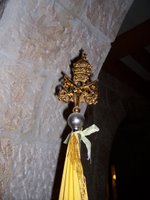
The tiara, keys and sedia...

The fisherman from Galilee who was planted at the center of the Empire - Simon Petrus! He was crucified upside down, with his feet uppermost.

Anyone who has observed a good sheep dog at work with the shepherd will have noticed how the dog eagerly waits for a sign from the shepherd and is positively distressed until it gets the command. Peters was like that: without the Lord, he immediately became unsure, indecisive, blundering.

The figure of Peter is an impossibility, made possible only by the will of the One who created him.

The tabernacle veil...


From Rome's San Vitale…

There is the presence of the Redeemer under the veil of the sacrament. Then there is the tabernacle veil to remind us of this!
Since the late 1960s one does not see the tabernacle veil much, if ever. Like everything else, it was pitched by the moderns.
But I like to think of my Sovereign Lord as being veiled, as with all royalty, in such a mantle.

Rome headquarters of Opus Dei...

This is it folks and it's open to the public (visit to see the lovely chapel). I always laugh at the anti-Catholic fodder of the ramble about the "oh-so-mysterious Opus Dei" or of the "oh-so-mysterious Vatican corridors."

Actually, it's nice to visit here. It's located in the posh Monti Parioli. It's the old fascist Rome where they all built in the 1920s and 1930s. An E.U.R. lady once told me that if you say you live in "Parioli," they you are considered really chic by the Romans (I could just hear the envy in her voice!).

Roma Aeterna...

Pope Leo I thanks Providence for having safely hidden the Christian faith in the fortress of Roman imperialism:

“So that the effect of the ineffable divine grace may be spread over the entire world, God in his providence provided the Roman Empire…It was most appropriate for the divine plan to have many states of the world united in one empire, thus making it possible to disseminate quickly the universal message of the gospel to the nations, because all were under the rule of one state.”

Leo I, Sermo 82.

Study in Rome with us...

Even if you study in Rome, you might be able to work here, too. This dude, one of my first friends in Rome, worked at the Mexican embassy. He used to invite us to benefit parties there. He was a fierce Catholic and liked to dace the rumba, too.

Study in Rome with us...


In Rome you can study bioethics, canon law, philosophy, social sciences, theology, etc. Study at Santa Croce or the Regina Apostolorum or l'Angelicum or la Gregoriana, etc.

Glory found mostly in Rome...


“When a priest celebrateth, he honoreth God, he rejoiceth the angels, he edifieth the Church, he helpeth the living, he obtaineth rest for the dead, and maketh himself partaker of all that is good.”

Thomas a Kempis: The Imitation of Christ, 4, 5 (15th cent.)

The Bavarians in the Urbs...


Der Vatikan als Weltmacht…!

A-r-r-r! It’s just glorious to see the colors of Catholic Bavaria being unfurled in the Roman wind! Bayern! It's my most favorite flag. Italian youth like to get their hands on this flag for beer parties (I know because one asked to buy mine!).

The return of the la cappa magna...

Well, for starters it sure is great to at least see one (albeit in a museum in Lourdes)! If you're wealthy, visit Signor Gammarelli in Rome and order one to be made for your bishop and once you (a layman!) give it to him, he might even then decide to wear it now and then?

Monday, February 05, 2007

Biretta of a Canon of St. Mary Major...


See the F.S.S.P. Rome blog for the photos of the Missa Pro Defuncto Sacerdote that was In Die Trigesemo for Franciscus Maria Quoƫx des Clefs Genevois: www.fsspinurbe.blogspot.com .

Cardinal Pell and the Aussie Catholics...

Ah, the glory of the Roman rite - a universal rite! This photo is of George Cardinal Pell while making a visit to the Maternal Heart of Mary Chapel in Lewisham, Australia.

See this great new Aussie blog and know that Ecclesia non moritur (the Church does not die): www.thomasperegrinus.blogspot.com

The Classical Roman Rite in Rome...


If you're looking for a devout Mass while in Rome, be sure to visit here for Sunday Mass at 10 o'clock. It's the parish of the Gesu e Maria (Iesu Et Mariae) on the Via del Corso. After Mass, too, it's always a nice Sunday stroll down to Piazza Venezia or down the Via dei Condotti.

The languid culture...

How does one describe the culture here? Many from back home just dismiss them all as being a "lazy" people. Instead, I prefer the word "languid." I relate to them only because I, too, so enjoy leisure!

Overlooking the sea near Rome...

Italy is so blessed to be surrounded by the lovely sea! While in Rome, even in the winter, be sure to visit the sea. Just take the train to Anzio or Ostia or Ladispoli, etc.

How eloquent! Carved on the facade are the Latin words: SALVE MARE TRIVMPHANS SVB LVMINE SOLIS.

del Corpo dei Vigili Urbani di Roma...


A tour book on Rome will explain this intersection as being the de facto center of Rome for auto traffic.
Everybody loves this guy and so every tourist stops on this corner to take a photo of him! It wouldn't be Rome without his frustrated frown and whistle.

Virgo Sponsa Dei: la sorella italiana...

It was a delight to chat with this sweet Italian nun. She so inspired me with her joy, wisdom and talent: all for the Church!

Teach your kids Catholic talents, too. Have them taught how to read music, play the organ, sing chant, etc.

Battle of Lepanto: courage of past generations...


Here we see the tomb of a survivor of the famed Battle of Lepanto - the grave of an authentic warrior of Western Christendom. He's buried in Rome, near to St. Mary Major, in the parish for the Filippino diaspora, the Basilica of Santa Pudenziana.

St. Thomas Aquinas in Laziale travertine...


At Rome’s Angelicum I found myself walking along the cloister while enjoying the afternoon breeze from the open arcade in front of the aula magna.

I was having one of those great conversations that one has among students of theology. Then we paused to ponder this beauty cemented on the faƧade of the aula magna which was constructed in the early 1930s.

My friend happens to be a “monarchist.” One doesn’t meet many of them back stateside, but it sure is a delight to hear their wisdom on the subject of governemnt. He was even able to quote Aquinas on the topic verbatim: “The rule of one man is therefore to be preferred to the rule of many, although perils follow from both.”

St. Thomas Aquinas: The Governance of Rulers, I, 5. (13th cent.)

Confess your sins in Latin...


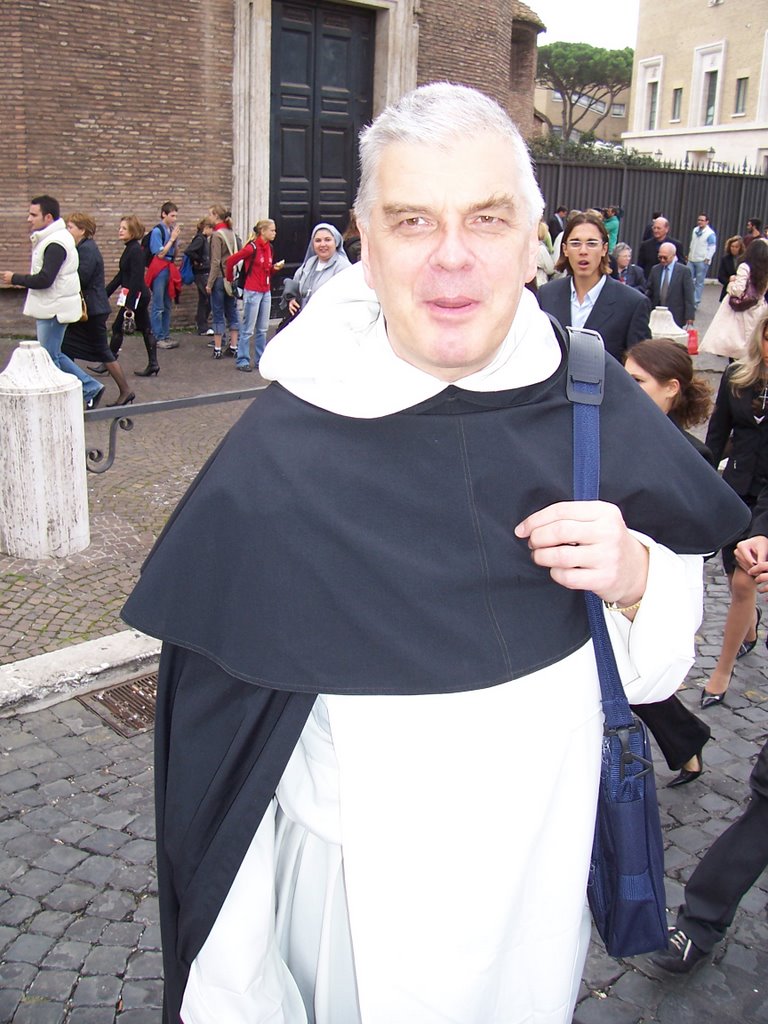
While in Rome you might prefer to confess your sins at the Basilica of Santa Maria Maggiore. The Dominican friars there are all fine men and stellar in the confessional.

Not to mention, it's just glorious to confess in Latin, too! This Belgian friar hears confessions in ten plus languages! He's saint, and a psychologist, too.

February 7: Feast of Blessed Pius IX...

Compared to that of the universal Church, the Diocese of Rome has a much richer liturgical calendar. On Wednesday we will celebrate the feast of (our beloved) Pio Nono. This is a photo of his tomb behind the grill at the Basilica of San Lorenzo near Roma Termini.

Blessed Pius IX, pray for us!

In Rome: Italian Franciscans on the road...


Italian Franciscans seem to still, for the most part, get an even number of vocations. It's nice to see the appeal still there:
“Christian heroism has not the same sources as heroism of other kinds. It has its source in the heart of a God scourged and turned to scorn and crucified outside the city gate.”

J. Maritain: Freedom in the Modern World (20th cent.)

Women who cover their heads in His presence...


Isn’t catholicity rich? These lovely Catholic ladies say a thousand words with their veils, namely, to the enemies of Catholic culture: “Farewell, auf wiedersehn, adieu, adieu, adieu to yieu and yieu and yieu…”

Last night, while smoking my King Edward (VII) Specials (from T.K.) and enjoying my Coke and grenadine (Rose’s – by appointment to Her Majesty Queen Elizabeth II), I found myself contemplating these sweet girls and wishing I could marry one of them…

“Moreover, let all the women have their heads veiled with a scarf but not with a veil of linen only, for that is not a sufficient covering.”
St. Hippolytus: The Apostolic Tradition, 18. (3rd cent.)

The often simplistic view of Pope Paul...


We have all heard disparaging things said of Pope Paul in the overheated, nearly hysterical atmosphere of the years during and after the cultural revolution, of which the Vatican Council slightly overlapped.

Sometimes I don’t think that he gets an even shake from many, but instead, the usual oversimplification.

Either way, I couldn’t help but have a wicked little smile when I was told the story of how when Paul, in good Leonine tradition, made a speech before the the World Council of Chuches in Geneva, he started with the words, “I am PETER!”

February 5: St. Agatha of the Goths...

This is the Rome parish of St. Agatha of the Goths (just behind the l'Angelicum). The tomb of Enrico Cardinal Dante is located in the crypt here (ask the sacristan to take you down to see it).

The body of St. Agatha lies in Catania, Sicily, but there is a great reliquary with some of her bones in this church in Rome which is displayed on the side altar. If you visit on a weekday, enter by the side door around the corner.

February 3: St. Blaise Day...


Friday we celebrated Candlemas Day and and on Saturday we had our red vestements for St. Blaise Day.

San Biagio is a nice festa in Rome. For the throat blessing I always go to is visit his Armenian chuch on the Via Giulia in the centro storico.
When you enter this parish on this day you will see a cleric in the rear of the church at a table. You take some bread from the dish, leave some change as a donation and kneel for the blessing. It's a sure must if you're ever in Rome on a February 3.

February in Italy...


When it’s warm out it’s nice to pranzare on our covered balcony (ma sei matto!). The poor student living in Italy eats gallina (hen) because it’s cheap. Why is it so cheap? I don’t yet know, but it could be because the outer skin is so hard to chew.

Actully I haven’t seen snow now in over three years. But I sure do miss the old Swiss Mix hot chocolate in the chalet (ground roasted cacao beans there are in Italy, too, but latte e cacao/cioccolato just tastes a little different). Viva la antica latteria di montagna...latte, buonissimamente latte!

To destroy heresy: the chubby, rosy cherub...


Oh joy! Do you see what the grinning little cherub is doing (in Rome's Jesuit parish, Il Gesu)? He’s destroying the fodder of heresy!

“Here is the badge of heresy: its dogmas are unfruitful; it has no theology. Deduct its remnants of Catholic theology, and what remains? Polemics, explanations, protests.”

Card. Newman: Oxford University Sermons. (19th cent.)

Window shopping in Roma Beata...


There's only one city in the world where you could ever hope (today) to see anything as beautiful as this in a store window. I guess it's just all another day in la Capvt Mvndi!

Overrun Europe: the tidal wave of Islam...

A philosopher in Rome might explain to you that the real counterpoise to belief is "inattention." Why is inattention the friend of the devil? Perhaps the devil seeks our inattention so as to get his work done. The devil will tell you that Western Christendom is already dead, but I still see it just dying...

The Islamic nations built the largest mosque in Europe, with great strategy, in Rome (financed mostly by the Saudis). I've seen it, near to the famed Ponte Milvio. Only since these recent years now do we see here these many, many thousands of Mohammedans who crawl all over Rome, Milan and the rest of Europe. You see them in the cruddy suburbs of Rome or on the subway/tube on a Sunday morning. They always arrive in Italy in overcrowded boats from North Africa - boats loaded with mostly men and some pregnant women.

When altar missals were beautiful...

The full import of beauty should always be enjoyed in the liturgy - even in our printed altar missals. Of course human reason will never be able to fathom the event concealed in the sacred liturgies, but we can at least enjoy the beauty as much as our five senses allow us to.

Ever since I was a kid I noticed that the typography and layout of the old missals from before the late '60s was really lovely and that today we're barred from that former beauty courtesy of the publishing houses/spirit of the age.

I wish we had more of the element of "descent" and "dependence" in keeping the new prints of today looking as lovely as they formerly had. But then again, lest we succumb to the lures of beauty we might look "too" Catholic and that would just be the worst thing, right?

Roman tailors: to make a clerical hat...


Between Santa Maria Sopra Minerva and the old Collegio Romano is the firm of tailors, Barbiconi. At Barbiconi they actually still make hats for papal knights, clerics, etc.
I took this photo there while the kid/employee explained to me that this object is the oldest item in their store! You turn the wheel at the base to expand or contract the silver-looking part so as to fit the hat to the size of the mold as you create it.

Russian Catholics in Rome...

Most clerical students in Rome live in a collegio. This collegio was established for Russians and others by Pope Pius XI in the 1920s. It's across the street from St. Mary Major, near to Roma Termini.

Ring the bell and the porter will bring you into the gift shop on the main level. Also, after the sung Liturgy on Sundays in their attached parish, they often have tea time in the grand salon of the college which is nice to see, too.

Monday, January 29, 2007

Don Bosco: see him incorrupt in Turin...

One year ago at this time I found myself in Turin at the Olympic games. I was bored and so as I studied my map and saw this big basilica near to the cathedral. I hiked over there, and to my surprise, it proved to be one of the most inspiring moments of my life.

As I knelt in awe (liking the maniple and glitter of his body), I could hear a childrens choir in the gallery above the sanctuary. It was then that I realized that this locale had been his famous Oratory and that his work continued there even today.

Then I made my way to the little chapel across the square where Don Bosco used to pray. As I knelt, I could hear all the kids outside running and playing and enjoying everything that Don Bosco had built for them, through the grace of God. My thought was this: when abortion is made illegal, first in Russia, there will be even greater need for us to commit to the youth in Christ!

January 31: Feast of St. John Bosco

Here we see Don Bosco still standing with his kids in Torino. If you ever find youself in Turin to see the Holy Shroud, be sure to walk over to his old headquarters to check it all out (about a fifteen minute walk from the cathedral).

Don Bosco build a veritalbe little town there for his kids. You can see the basilica there with his incorrupt body (!) as well as his former rooms and chapel. There's even a little book shop there, still a giant school and even a little bar to have lunch in!

Rome Requiem for L'abbƩ Franck Quoƫx...


This Saturday, February 3, at 11:30 a.m. a Solemn Requiem Mass will be sung for the soul of Fr. Franck Quoƫx at the Roman church of San Gregorio dei Muratori (www.fssp-roma.org).

Photo courtesy of: http://hisluminescence.blogspot.com .

Saturday, January 27, 2007

New F.S.S.P. Rome blog...


See this new (unofficial) ad hoc news blog from the F.S.S.P. in Urbe: www.fsspinurbe.blogspot.com .

The Angelicum (Angelico)...


If you are a high school student or other, consider moving to Rome to study at this Dominican University for your Bachelor of Arts degree.
The good news is that if it's God's will for you to study here for your baccalaureate degree in philosophy, it's just a two year program (instead of the usual four back home) and the classes are all held in English (as well as in Italian) and are held just in the afternoons (mornings are left open to study - and see Rome!).

Friday, January 26, 2007

Rome's Dominican University...


Here we see Rome's Pontifical University of St. Thomas Aquinas (a.k.a. the Angelicum) as seen from the Vittoriano.

The belfry and two domes on the right horizon are of St. Mary Major. In the middle on the horizon one can see the Dominican convent of Sts. Dominic and Sixtus (with the battlements) and the church attached to it on the far left is the Church of Sts. Dominic and Sixtus.

The Dominican friars live in this clausura and the classrooms are on the main level. There is also a lovely cortile and giardino. One can boast that Pope John Paul II studied here from 1946 - 1948!

January 22: Feast of S. Vincezo Pallotti...


Everyone knows that for Latin Rite Catholics the liturgical calendar really took a big hit during the late ‘60s. But not everyone knows that the Diocese of Rome conveniently just kept so much of the gold and so has maintainted a much richer liturgical life than the universal rest of us! (But I guess a sure way to escape it is to just follow the Classical Roman Rite!)

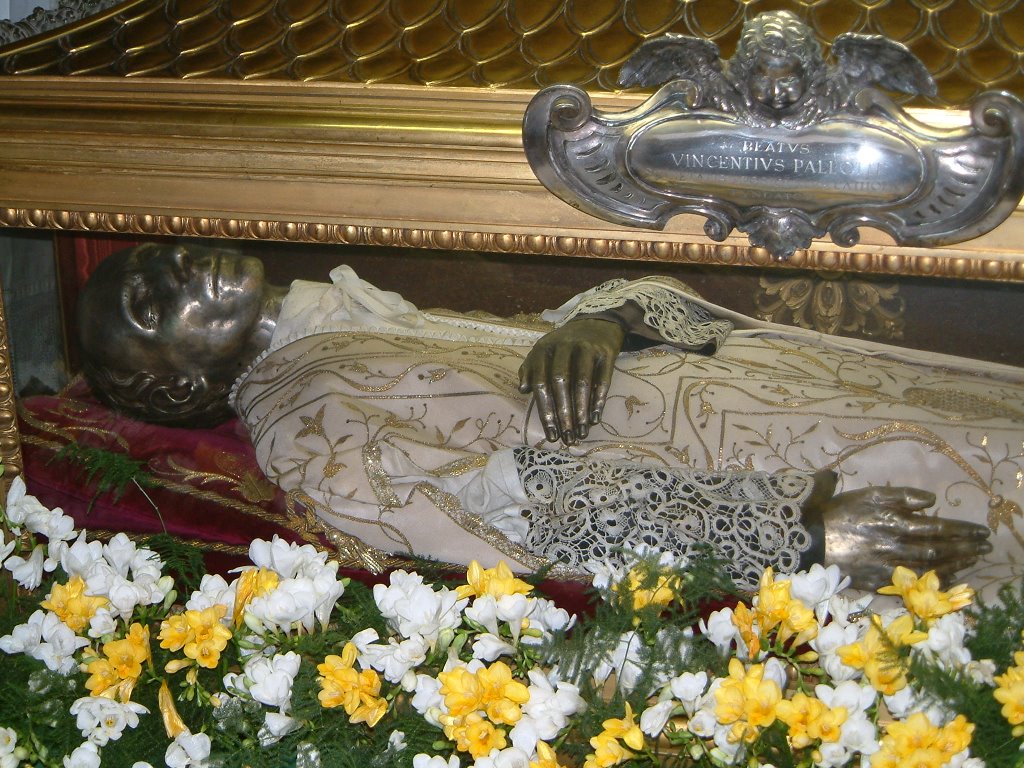
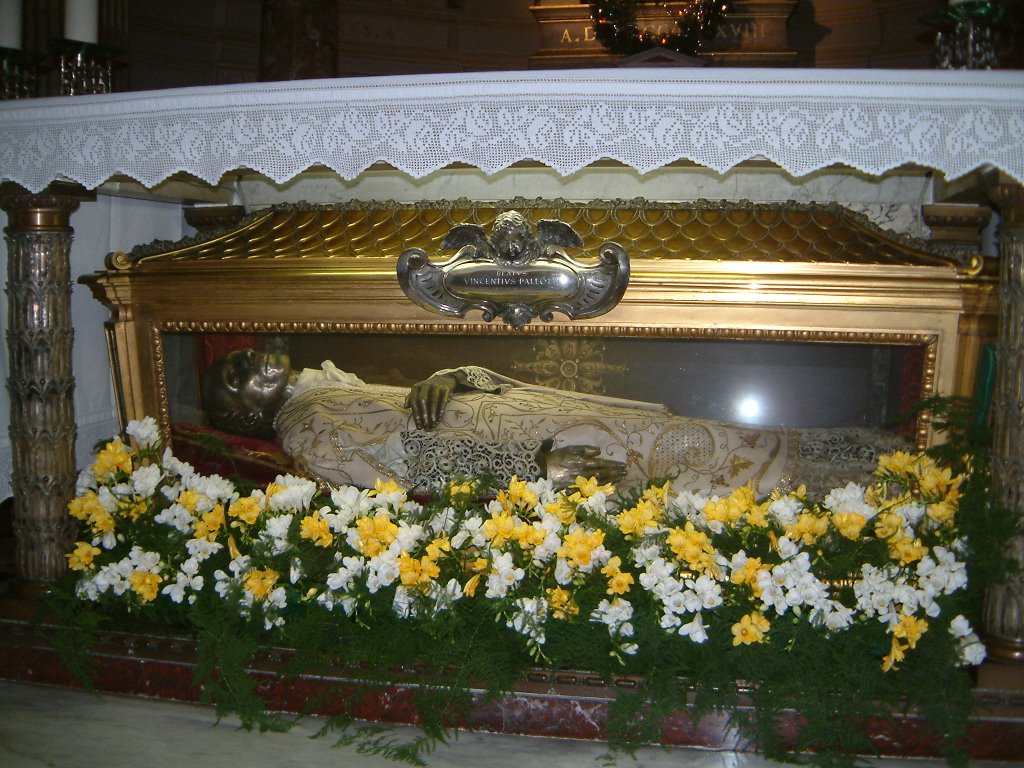
Monday in Rome we celebrated the feast of this saint, St. Vincent Pallotti, who is incorrupt and entombed in this Parrocchia Pallottina. He was the fondatore dell’Unione dell’Apostolato Cattolico. This is him as he rests in splendor under the altar mensa in the Roman parish del SS. Salvatore in Onda (Via dei Pettinari, 57 – near Ponte Sisto).

Founder of the Society of the Catholic Apostolate...


What can be learned from this saint whom we now look at? His parents were the decisive religious influence during his youth! After ordination he committed himself to keep alive the Christian faith of the inhabitants of Rome. He became an animator of collaboaration among clergy, religious and laity alike.

He was born in Rome and died there, too. He lived from 1795-1850. He was declared blessed by Pius XII in 1950 and was canonised a saint by Blessed John XXIII in 1963. He was the founder of the Pallottine Fathers (they serve everywhere and since 1998, in Russia, too). Since January 22, 1950 , this sarcophagus has contained the body of the saint.

Unio Apostolatus Catholici...


In 1835 he founded the pious union of the Catholic Apostolate, in which the baptized participate in missions of the Church as the realization of a common goal.

He stated when he founded it: “The Catholic Apostolate, that is, the universal apostolate, which is common to all classes of people, consists in doing all that one must and can do for the greater glory of God and for one’s own salvation and that of one’s neighbor.”

Follow him: you, too, be a Pallottine...


He’s buried inside of a church that was built at the end of the XI, beginning of the XII century. The first mention of this church is in a letter of Pope Honorius II in 1127. In 1844, Pope Gregory XVI consignd the church and the adjoining house to him for the community of priests and brothers of the Society of the Catholic Apostolate founded by him. He died in this church in 1850.

Monday, January 22, 2007

Abortion industry in Italy...


Here we see a little Italian at Rome's S. Andrea della Valle. How many of his contemporaries were killed by abortion in the year in which he was born? Circa 140,000...

To my Italian friends, see here to be informed of this corporate menace in your own nation: http://www.hli.org/mission_rome_2001.html

Octave of Christian Unity...


These days now we are praying in particular for Christian unity. We do this every year during this so-called "Octave of Christian Unity." It started last week on the old Feast of the Chair of Peter at Rome and will end on the Feast of the Conversion of St. Paul (18 January - 25 January, 2007).

If you have a copy of the Raccolta you'll see some great prayers in there for this octave of prayer:

First Day: For the return of the 'other sheep' to the One Fold of our Lord Jesus Christ.
Second Day: For the return of the Eastern Orthodox Christians to communion with the Apostolic See.
Third Day: For the return of the Anglicans to the authority of the Vicar of Christ.
Fourth Day: For the return of all Protestants throughout the world to the unity of the Catholic Church.
Fifth Day: That Christians in America [or: throughout the world] may be one, in union with the Chair of St. Peter.
Sixth Day: That lapsed Catholics will return to the Sacraments of the Church.
Seventh Day: That the Jewish people will be converted to the Catholic Faith.
Eighth Day: That missionary zeal will conquer the world for Christ.

January 21: Feast of St. Agnes...

If you're ever in Rome on a wintry January 21, take an early bus out the Via Nomentana and you'll see this lovely sight at the Chuch of St. Agnes!

Each year the nuns prepare two young lambs in this manner. They actually tie them down in baskets (the lambs don't bite, but try to eat the plastic flowers, so attenzione!).

The kids (and adults, too) stare in awe at the lambs and then try to pet the fur, still being cautious of the chops.

Then the lambs are processed into the church for a nice High Mass with the Canons of St. John Lateran. In this church are located the bones of St. Agnes (although her skull is located at S. Agnese in Piazza Navona).

Canons: the splendor of the local church...


I took this photo in Lourdes of two canons (I liked the rochet!). Stateside many don't even know what a canon is, but I've seen many, many of them in Europe in cathedrals/collegiate churches in Rome, Pisa, Florence, Naples, Paris, London, Cracow, etc.

It sure would be nice to have more such canons back home. See this great website for an American canon: http://pintabona.info/ .

Friday, January 19, 2007

Saturday: Feast of St. Sebastian...


Every year at the Roman catacomb of St. Sebastian, in the late afternoon on his feast day, there is a lovely procession (seen in the photo) with his chief relic, led by the faithful with candles, into his catacomb (catch the bus at the Lateran baptistry - hope to see everybody there!).

St. Sebastian, pray for us!

Wednesday: Feast of St. Anthony of the Desert...


Ciao, tutti! This is a photo of the Roman parish of St. Anthony of the Desert. Wednesday was his feast and so I made a quick visit there.

I ask every adult Catholic to please buy this book, a biography of his life (Vita S. Antoni), of which you can easily read in one day.

See here to order (it's entitled "St. Anthony of the Desert" for $5) : www.tanbooks.com .

Teologo della Casa Pontificia...


Not every Catholic has been versed in the more subtle distinctions of theology. And so I arrived in Rome to study the sacred science of theology thinking I knew it all and then learning that I knew – and still know – so little!

At the Dominican Univeristy in Rome you can meet this Dominican friar, who lives in anonymity, or you can even sometimes see him on the 64 bus!

He was my professor of Moral Theology and now he's the Holy Father's private theologian! The majesty of his incisive and resounding intellect convinced me from the start that he was the most brilliant professor that I had ever had the honor to study under. I was a privileged witness to his intellect and now, under his theological guardianship, the Holy Father collaborates with him daily. He is eminently Polish and Dominican, he is Rev. Dr. Wojciech Giertych, O.P.!

Even a pope seeking to avail himself of collegial and communal inquiry involving theologians goes without saying:

“We do not exclude (non excludimus) collaboration, because infallibility is not an inspiration or revelation but is granted the pope as a divine support. Therefore the pope has to employ (tenetur) – considering his office and the importance of the matter – all appropriate means to ascertain the truth and express it suitably.”

Bishop V.F. Gasser, 1213d (19th cent.).

The archetype of leadership: a priest with his sons...


When I think of the Old Testament election and consecration to God (he who has merited the priestly dignity), I think of this man, my mentor, “the” Monsigor.

He, through the grace of God, was to beget many spiritual sons through his generous paternity, one of which I am proud to be. He directed my passion for the sacred liturgy and made me the adult Catholic that I am today.

As a kid I pondered from the pew the rich symbolism of the Roman Rite. I contemplated and assimilated higher truth through liturgical beauty. Even the child in the pew thinks, abstracts and infers concepts through the mood and images. An image is not just a representation, but a manifestation of the thing itself.

It was the Monsignor who interwove it all together for me and so taught me the Roman Rite. He often instruected us: "A common birthright for us Catholics is to enjoy the liturgy as the Church has given it to us. In Her wisdom the Church has given us the liturgy as She desires it to be presented (nobody has to be creative with it)."

Pray for him as he rears his spiritual sons – even today – he’s eighty-six! His lovely sermons were often capped with this thought: “The Church is Jesus Christ! When you love Christ, you love the Church!”